


Académie des Industries Extractives (AIE) de la CEMAC
Cliquez ici pour télécharger le document
Cliquez ici pour télécharger le document
Cliquez ici pour télécharger le document
Cliquez ici pour télécharger le document
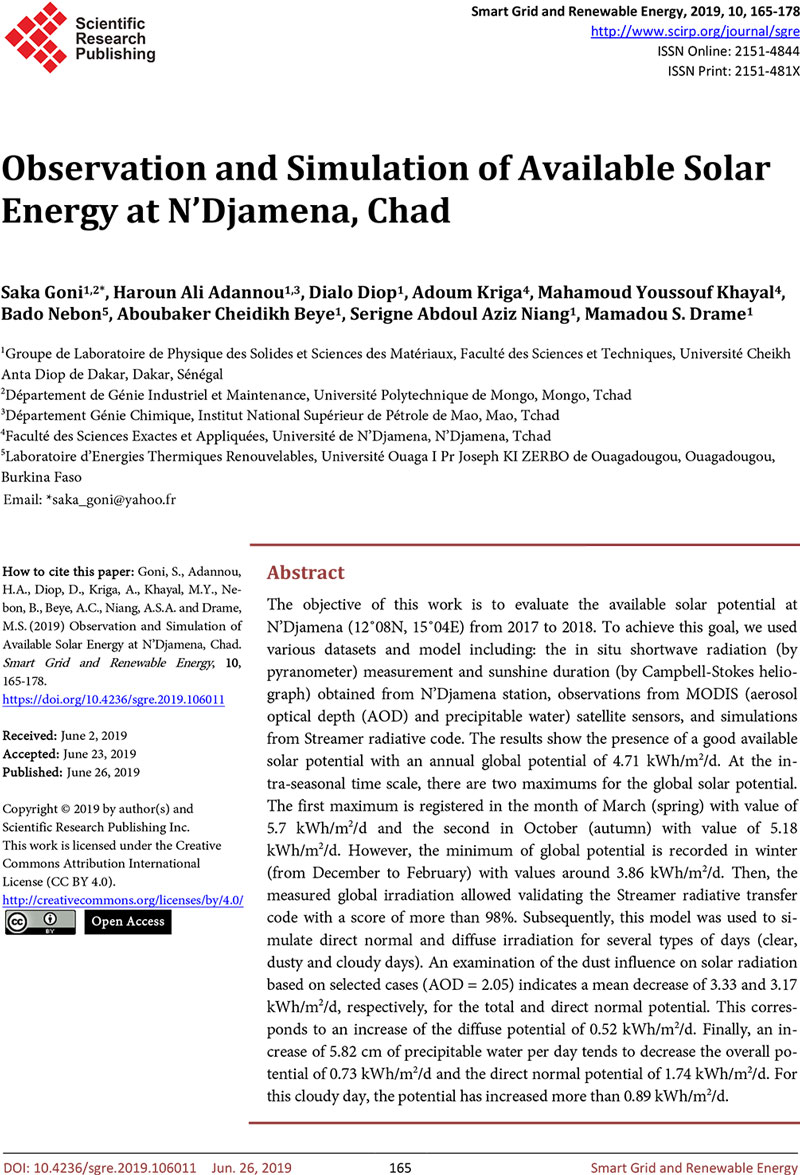
Abstract The objective of this work is to evaluate the available solar potential at N’Djamena (12˚08N, 15˚04E) from 2017 to 2018. To achieve this goal, we used various datasets and model including: the in situ shortwave radiation (by pyranometer) measurement and sunshine duration (by Campbell-Stokes heliograph) obtained from N’Djamena station, observations from MODIS (aerosol optical
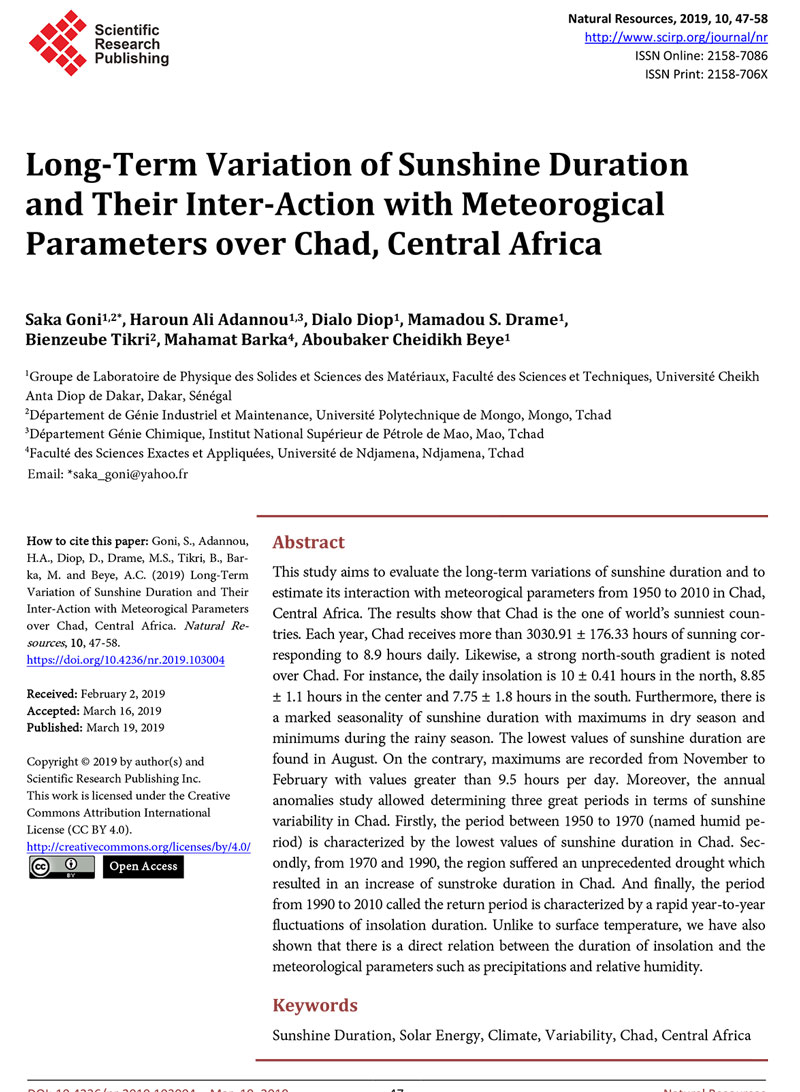
Abstract This study aims to evaluate the long-term variations of sunshine duration and to estimate its interaction with meteorogical parameters from 1950 to 2010 in Chad, Central Africa. The results show that Chad is the one of world’s sunniest countries. Each year, Chad receives more than 3030.91 ± 176.33 hours of sunning corresponding to 8.9
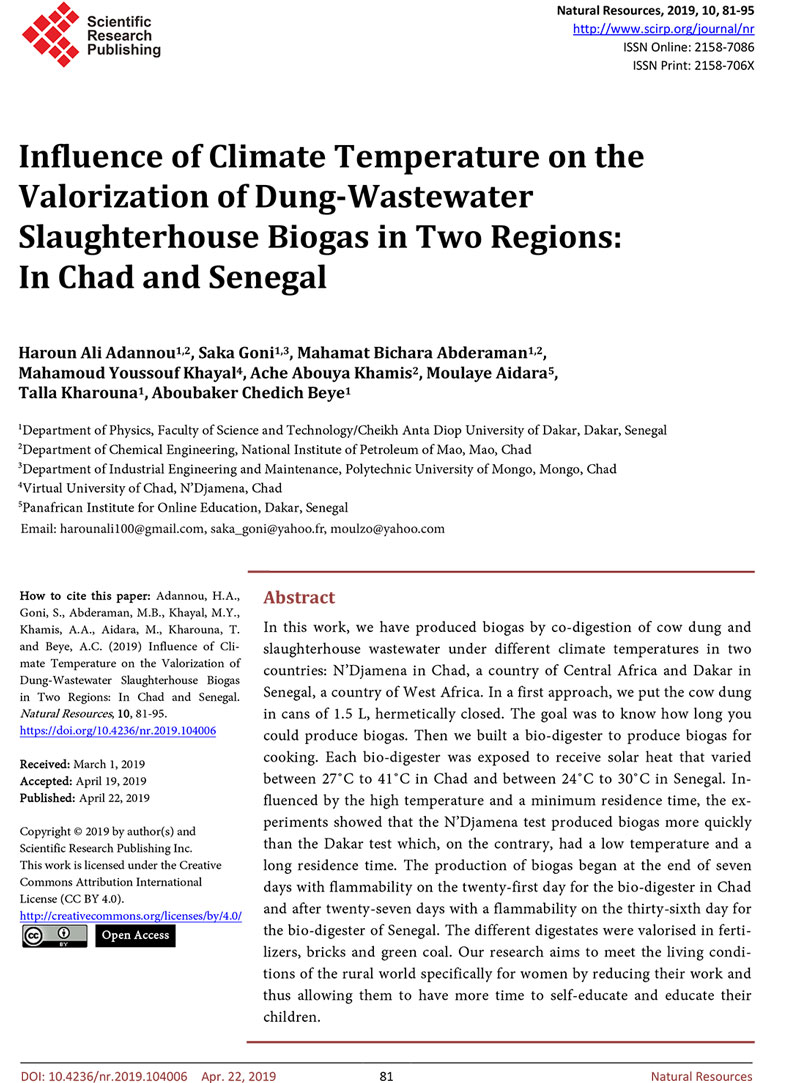
Abstract In this work, we have produced biogas by co-digestion of cow dung and slaughterhouse wastewater under different climate temperatures in two countries: N’Djamena in Chad, a country of Central Africa and Dakar in Senegal, a country of West Africa. In a first approach, we put the cow dung in cans of 1.5 L, hermetically
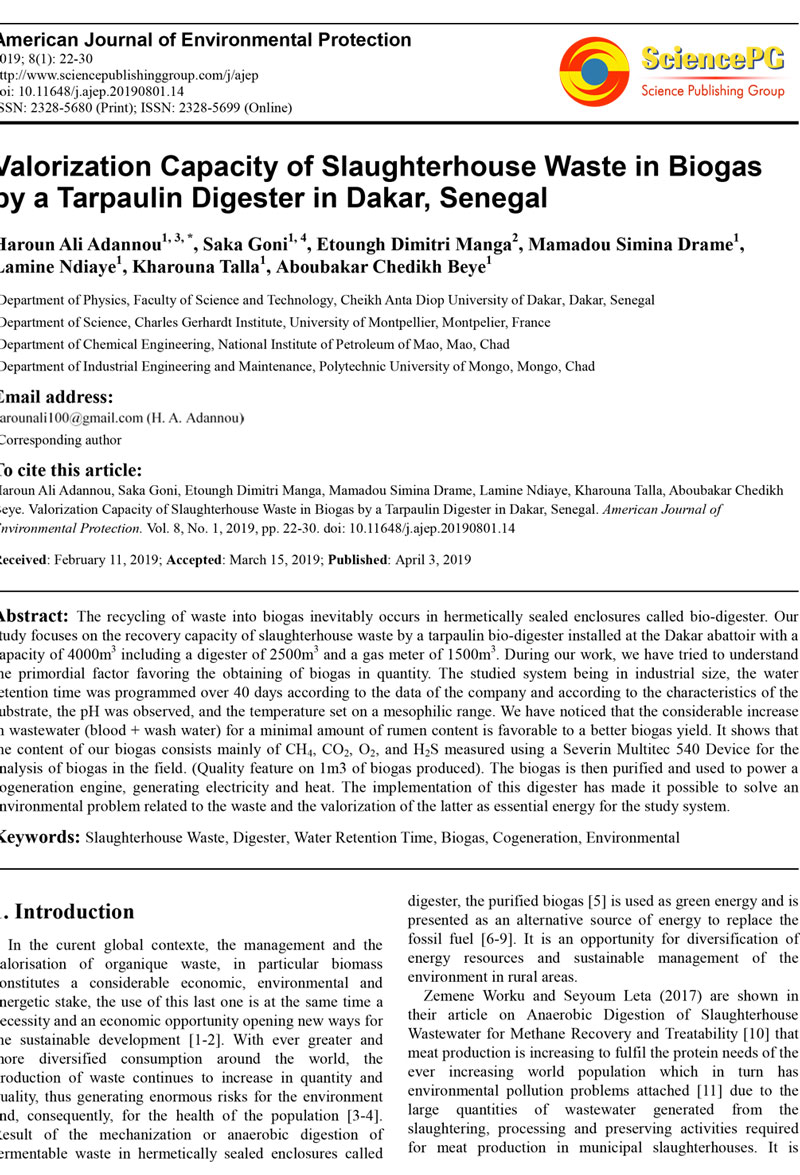
Abstract: The recycling of waste into biogas inevitably occurs in hermetically sealed enclosures called bio-digester. Our study focuses on the recovery capacity of slaughterhouse waste by a tarpaulin bio-digester installed at the Dakar abattoir with a capacity of 4000m3 including a digester of 2500m3 and a gas meter of 1500m3 . During our work, we
Abstract In this work we undertook a series of experiments to evaluate the biogas potential of the waste from the UCAD university residence. The first experiment revealed several types of waste at room temperature in a 1.5-litre canister equipped with an empty inflatable balloon used to recover biogas, which was our bio-digester. A shaking is